> For the complete documentation index, see [llms.txt](https://docs.polkagate.xyz/polkagate/llms.txt). Markdown versions of documentation pages are available by appending `.md` to page URLs; this page is available as [Markdown](https://docs.polkagate.xyz/polkagate/polkagate-extension-user-guide/organize-accounts-in-profiles.md).
# Organize Accounts in Profiles
In PolkaGate, you can organize your accounts into different profiles. Advanced users often have a considerable number of accounts, and organizing them into profiles such as staked accounts, validators, test accounts, proxies, watch-only, and Ledger accounts can help manage them more efficiently.
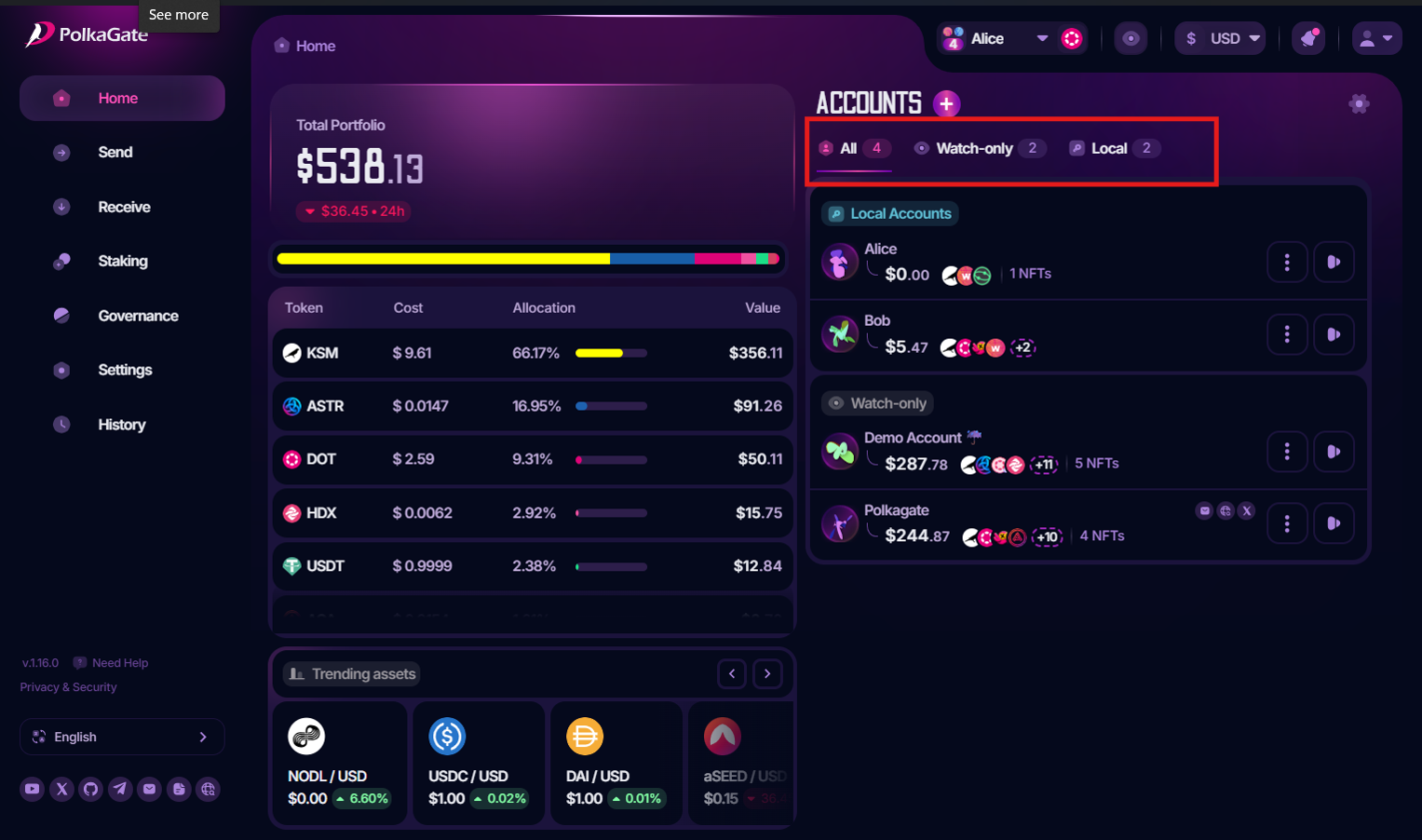
By default, the extension will show system-defined profiles: All, Local, Watch Only, and Ledger. However, users can also add their accounts to user-defined profiles.
Profiles can be easily switched from the top of the **Accounts List** on home page in full-screen mode, or from the **Accounts List** page in extension mode, as shown below.
Home page (full-screen)
Accounts List (extension)
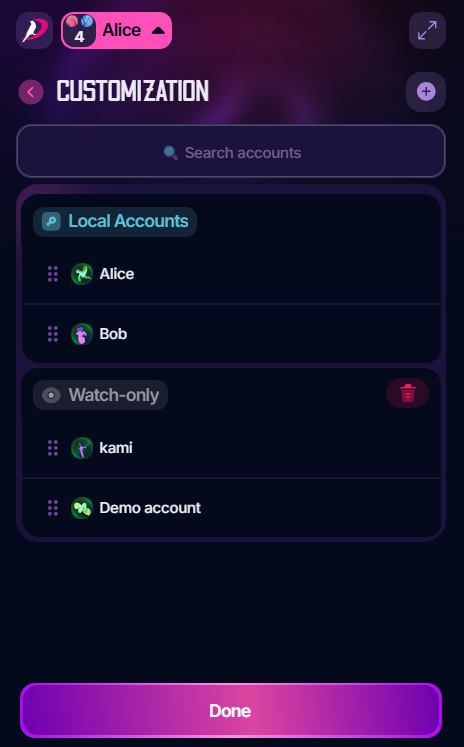
To **add an account to a profile** or **create a new profile**, open **Accounts List** (the page shown above) in **extension mode** from the top menu next to the PolkaGate logo, then click the **⚙️ Settings** button:
Profile management (extension)
On this page, you can easily **delete profiles**, **search** for existing ones, and **drag and drop accounts** to add them to a profile.\
To create a new profile, click the **➕ Add Profile** button.
New Profile (extension)
Choose a **name** for your new profile, then click **Next**.
New Profile (extension)
Select the **accounts** you want to include in the profile, and click **Add Accounts**.
**Note:** The profile creation process is the same in **full-screen mode**.